WorldCat is going to be free to the world! According to this story in Information Today, it will go live sometime in August.
So what? You may ask. Or even, What the heck is WorldCat and why is she so excited about it? This is the mega-catalog of over 70 million book records shared by libraries worldwide. When their "find in a library" program was announced I thought it was cool, but the links to library availability weren't easy to find in a general search, and it was only a miniscule mere 3-4 million records. "Why not make the whole thing free and searchable in one place rather than hidden among a billion bookseller links?" I wondered. Well, finally OCLC will do that. Previously the only public access has been through libraries subscribing to it as a database, just another hard-to-figure-out database among dozens.
I'm excited! And it sounds as if the interface could do some very innovative things. It will be terrific if people can hop on the web and find out what's available in area libraries without having to go to specific library sites and figure out their various catalogs. If we want people to find us, we should be as easy to use as ABEbooks and Amazon. Because we know from their experience people really do want books.
Saturday, July 22, 2006


Thursday, July 20, 2006
Finding the Right Match
There's an interesting post over at librarian.net ("putting the rarin' back in librarian") about the Canadian effort to recruit people into the field. Not just any people, but those who will bring the leadership skills and creativity the profession needs. There has been some controversy over a US federal grant intended to bring more people into the field by getting more PhDs who can teach in library schools - and since there are always librarians who will complain about their education being a) boring b) irrelevant c) too easy d) too theoretical, including the past president of the American Library Association, Michael Gorman, cranky comments come up a lot in blogs. (Michael Gorman comes up a lot too, but that' s another story.)
The Canadian effort, though, is smart in that it doesn't focus on a supposed shortage (which is a hard argument to swallow for young librarians who don't find jobs as easily as they were led to expect as geezers like me fail to drop by the wayside) but rather on the value of the profession and finding people who are a good match for its challenges.
I must be a geek (and a nerd), I enjoyed library school, especially the theory. But the fact is if you're a librarian you're going to be learning for life, so don't expect a measily year of graduate study to be anything but the beginning of your education. That must be why I like it so much!
The Canadian effort, though, is smart in that it doesn't focus on a supposed shortage (which is a hard argument to swallow for young librarians who don't find jobs as easily as they were led to expect as geezers like me fail to drop by the wayside) but rather on the value of the profession and finding people who are a good match for its challenges.
I must be a geek (and a nerd), I enjoyed library school, especially the theory. But the fact is if you're a librarian you're going to be learning for life, so don't expect a measily year of graduate study to be anything but the beginning of your education. That must be why I like it so much!
Tuesday, July 11, 2006
Jimmy Carter on freedom of information
He may not have been a great president, but he's an excellent elder statesman. Read Jimmy Carter's op-ed on free access to government information.
Monday, July 10, 2006
Disciminating against homeless patrons?
Yikes. Would any of our public librarian readers/writers like to respond?
Community College Librarianship
I was recently speaking with a peer in my library program who said she heard taking her first librarian position at a community college made it more difficult for a friend to get a position in a traditional academic library later. Has anyone else heard about or had experience with this? I would be interested to know since this seems to be a growing area of librarianship.
Saturday, July 08, 2006
Pentagon funding academic research to limit Freedom of Information Act
Arguably one of the most important laws related to access to information is the Freedom of Information Act, which celebrated its 40th anniversary on Tuesday, July 4, 2006. (A neat coincidence.) You can read about your rights under the Act here. So, isn't it ironic to learn that the Department of Defense is now funding a study to a tune of one million dollars that will find ways to limit the law?
Tuesday, June 27, 2006
Letters We Hope We Never Receive
Now that there's no real point in gagging "John Doe," the FBI has dropped its objection to speaking out. If you're wondering what a National Security Letter looks like, now you can see one.
Better yet, the feebs are dropping the request for the library records. Sometimes you can fight city hall. You just can't talk about it without a fight.
Better yet, the feebs are dropping the request for the library records. Sometimes you can fight city hall. You just can't talk about it without a fight.
Saturday, June 10, 2006
A Distant View
If you're considering library school, you may be in a situation (due to work or family commitments) that make it difficult to move in order to pursue an LIS education. This spring, Laura MacPherson, who just graduated from Gustavus and is entering the field, conducted a literature review of distance education options in LIS education. Though there is a lot of criticism of the effectiveness of distance ed generally, she didn't find anything in the research that suggested distance ed in and of itself was a bad option for the field of librarianship. Faculty are working on ways of giving it a personalized, human touch; employers are not generally discriminating against graduates of distance programs, and students are largely pleased. One finding that was especially interesting is that most LIS programs today blend traditional face-to-face instruction with aspects of distance ed - so that when employers were asked whether they were leery of hiring grads of distance programs, many found the question impossible to answer; in most cases their recent hires had all taken distance courses.
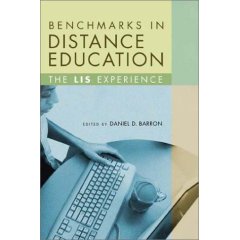
Laura recommends a book edited by Daniel Barron, Benchmarks in Distance Education: The LIS Experience (Westport, CT: Libraries Unlimited, 2003). She calls this the "ultimate source" on distance ed in library education. This collection of essays addresses a wide swath of issues of interest to students thinking about a distance program and for teachers embarking on teaching this way. It's pricey - you may want to look for through your library!

Laura recommends a book edited by Daniel Barron, Benchmarks in Distance Education: The LIS Experience (Westport, CT: Libraries Unlimited, 2003). She calls this the "ultimate source" on distance ed in library education. This collection of essays addresses a wide swath of issues of interest to students thinking about a distance program and for teachers embarking on teaching this way. It's pricey - you may want to look for through your library!
Wednesday, May 31, 2006
Ungagged
Four librarians who were served with National Security Letters and placed under a gag order are finally free to speak up - once the "danger" of discussing the PATRIOT Act before its reauthorization had passed the government decided not to fight against their challenge of the gag order. (Hey, they might lose, and then where would we be? Able to talk first-hand about a controversial law? Horrors.)
See articles in the Boston Globe and The New York Times.
See articles in the Boston Globe and The New York Times.
Monday, May 08, 2006
Peer review patents
Copyright, trademarks, and patents are ways that the government regulates information. In order to tackle the huge backlog of patent applications, the US Patent and Trademark Office will be launching a pilot of a public "peer review" patent system. The goal of the project is "to ensure that patent examiners will have improved access to all available prior art during the patent examination process." There's more here and here. [Via BoingBoing.] If I understand the concept correctly, it's ingenious. I can't wait to see how it works out.
"Traditional" media appear to be struggling...
One of librarianship's research concerns is information-seeking behaviors. It appears that two popular ways of seeking news information (newspapers and cable news) are becoming less so, as some speculate that more people turn to the Internet for news information.
Newspaper circulation declines 2.6%...
Median age of Fox News and CNN viewers is over 60...
Newspaper circulation declines 2.6%...
Median age of Fox News and CNN viewers is over 60...
Wednesday, April 26, 2006
Geek or Nerd?
Rory Litwin has a thought-provoking piece over at Library Juice.
I also think this may be a dichotomy that's more likely to apply in large and/or academic libraries. It's my impression that public librarians are less interested in technology or bibliographic knowledge than they are in people and their needs. (Am I being a romantic, Charlotte?)
Perhaps the most pressing issue facing librarianship is one that is unlikely to receive serious scholarly attention. It is, to put it simply, a battle presently being fought between two camps of librarians. Some may cite generational conflict as the primary conflict in librarianship today; baby-boomers representing traditional knowledge of librarianship as well as bibliographic knowledge, and GenXers representing facility with technology. There is some truth to that picture, but it is primarily a distraction from the real conflict. That conflict, I submit, is the battle between geeks and nerds.It's half tongue-in-cheek, but made me think. I'm not at all convinced this is generational - or, at least the young librarians I know are hardly uncritical about technology, even if they're more up-to-speed with it than some of us (ahem). And there are a number of gray-haired academic library directors who I've speaking at conferences about the latest technology as if its a religioud sacrament.
I also think this may be a dichotomy that's more likely to apply in large and/or academic libraries. It's my impression that public librarians are less interested in technology or bibliographic knowledge than they are in people and their needs. (Am I being a romantic, Charlotte?)
Tuesday, April 25, 2006
Here we go again: Congress readies broad new digital copyright bill
Librarians have numerous concerns about new copyright laws and regulations. Will they inhibit library preservation work? Will they have a chilling effect on the creation of new works? Will they take away the rights we already have? Etc., etc., etc. (Be sure to study the issues in library school.) Congress is at it again. Read up and speak out.
Wednesday, April 19, 2006
A Day in the Life
Ria Newhouse is a young librarian who's on the cover of Library Journal. She describes her life as a librarian in her 20s working at Metro State in St. Paul, Minnesota after a stint as a teen services librarian.
I have learned so much in this job. I know how to chair a search committee, how to cry gracefully (and not so gracefully) in a meeting. I know that librarianship is a career that allows one to eat too much candy. I've learned that if you ask for what you want enough times, you might just get it. I learned that I enjoy teaching, even if it does make me nervous.
There are different kinds of lessons, too. I can be both professional and personal at the same time. It's a hard balance to maintain, but it's something I'm good at. It's okay to have a heart, to show some emotion, to say what you think, and to wear a skirt that buttons up the side. I've learned that I am provocative, smart, funny, and quite sassy. I am a valuable part of this profession and a day in my life is something I would never want to miss.
(For the record, I've been to a lot of library meetings and though they've been stimulating, frustrating, sometimes dull, sometimes contentious, I have never been brought to tears. That's not to say we always agree, but those disagreements are usually the most interesting part.)
Thursday, April 06, 2006
Rankings Released
US News & World Report has updated its stale ranking of LIS programs. I'm not sure that's a good thing, since I think the whole rankings game is misleading, but at least we're being as misled about library graduate programs as other grad. programs. Woo-hoo!
Library Journal offers the top ten - or rather, the top seven, with several schools tied for places. And adds a grain of salt or two.
Library Journal offers the top ten - or rather, the top seven, with several schools tied for places. And adds a grain of salt or two.
Sunday, March 26, 2006
"Are search engines making students dumber?"
While it is impressive that the concept of information literacy has hit the op-ed pages of the New York Times, the author of the piece discusses it rather clumsily, if you ask me. I'm not sure one can make the cause-and-effect claim that search engines are causing more students to be unprepared for college. Judge for yourself.
Wednesday, March 22, 2006
Invisible Man
The "new and improved" PATRIOT Act (okay, my tongue is firmly in cheek) hasn't made it any easier for John Doe to talk about the impact of the act. In fact, John can't collect his award for standing up for freedom of expression because standing up can get you arrested, that is if it means anyone can see who you are. Hmm, what if he wore a paper bag on his head? Or what if he came pre-pixilated, like these fashion staements?
Saturday, March 18, 2006
Generation Stereotyped
Recent issues of American Libraries and College and Research Library News have both had articles on how to cope with the new generation of librarians. It sounds as if the old guard needs a guidebook. How can we understand these uppity young people? They're so odd. It must be all that multitasking, or is that they love technology?
Or is it that some librarians can't resist classification? By age.
Angel, the Gypsy Librarian, has a long and thoughtful post about all this (which is no surprise; all of his posts are thoughtful). Personally, I think it's time to drop this peculiar form of stereotyping and get on with simply being professionals who respect one another and don't stoop to ageism, e.g. you're young, so likely to rebel; I'm old, so likely to cling to protocol. Ah, baloney!
Or is it that some librarians can't resist classification? By age.
Angel, the Gypsy Librarian, has a long and thoughtful post about all this (which is no surprise; all of his posts are thoughtful). Personally, I think it's time to drop this peculiar form of stereotyping and get on with simply being professionals who respect one another and don't stoop to ageism, e.g. you're young, so likely to rebel; I'm old, so likely to cling to protocol. Ah, baloney!
Wednesday, March 15, 2006
New Career Site
According to AL Direct, the new e-mail based weekly news service for American Library Association members, there's a new ALA Website on careers in the field. I'm not sure what to make of this one. It's intended for both paraprofessional and professional careers, which is fine, but the organization would confuse anyone who doesn't know the difference. One page says getting an associates degree is a good idea, then mentions later on the page "Assuming that you have decided a career as a librarian is probably not for you . . ." If you get to this page from the menu, you may in fact have not decided against a career as a librarian.
Seems more than a little confusing to me. The New Jersey site, Become a Librarian, has been around for a while and has quite a lot of good info. It doesn't offer anything for people who don't want to become a librarian, however.
Seems more than a little confusing to me. The New Jersey site, Become a Librarian, has been around for a while and has quite a lot of good info. It doesn't offer anything for people who don't want to become a librarian, however.
Sunday, March 12, 2006
Looking Ahead
There's a somewhat sobering essay in the current issue of American Libraries - on MLS graduates who are looking for work, or those who choose a paraprofessional career path to avoid being overqualified for the job market. The current information about the field in the Occupational Outlook Handbook offers the good news - there will be a lot of retirements - along with the bad news - with budget cuts, some of those positions will disappear.
One thing it's fair to say: it's going to remain an interesting field, full of change and challenges, rewarding for those who are looking for both.
One thing it's fair to say: it's going to remain an interesting field, full of change and challenges, rewarding for those who are looking for both.
Subscribe to:
Posts (Atom)