Sony has finally released their eBook reader into the US market. Electronic paper, anyone? Read about it and an alternative at MetaFilter.
Although a bit dated (2001), simply the best article about the important legal and cultural issues related to eBooks is Clifford Lynch's The Battle to Define the Future of the Book in the Digital World.
Wednesday, September 27, 2006


Friday, September 22, 2006
Interesting Job Opportunities
The field of librarianship is full of interesting, unusual job opportunities. Consider this one at Guantanamo Bay, for example.
Wednesday, September 06, 2006
Open Sources
Here's a cool idea! Make searching better than Google by having a real, live person help you! Wow that's innovation! That's really forward-thinking! That's really ... exactly what libraries do, and have done for years. By phone, by chat, in person. Whatever works.
Why is it that so many people still don't think of the library when they get frustrated doing a Web search? I guess that's what the OCLC Perceptions report was all about - though it annoyed me when I read it, thinking they were dismissing people's genuine interest in books.
I wonder if the problem isn't that libraries are local, and Google is everywhere, always? So many libraries have scaled back on hours and can't answer reference questions exept for the few hours a week they're open - unless they pay to be part of a chat reference service, which costs money and hasn't, so far as I know, been widely adopted by users enough to make a strong case to the bean counters who closed the library in the first place.
If we can't be there to provide reference on line or in person, or are only there thirty hours a week, most of them when people are at work, we'll have a hard time convincing people helping them find information is what we do.
Gee, maybe this guy's idea makes sense after all ....
Friday, September 01, 2006
E-Government and Libraries
Here's an interesting article in LJ about how essential libraries are becoming not just as sources of government information but as places where people participate in government. And man oh man, are there a lot of implications! Not only resource issues (how will we afford to replace those old computers?) but service and education issues (how will we help that little old lady learn how to sign up for their benefits? Or how do you help your patrons apply for FEMA relief if your library has a hole in the roof and no power?) The recommendations are sound, but what a lot to think about!
And how ironic that while libraries are becoming essential for two-way communication with government, there's legislation in the works that is designed to turn off social networking sites in libraries.
You can't have your space, but we won't talk to you unless you do it online. Sincerely, Big Brother.
Thursday, August 31, 2006
Attending Library Conferences
I am excited to be attending my very first Minnesota Library Association Annual Conference this year. I will be volunteering for all three days of the conference, but will also get to attend any conference sessions that don't interfere with helping out.
Does anyone have any tips for attending professional conferences like this? Is there anything I should know/be prepared for before I go?
I'd love to hear any tips, advice or anecdotes people have to share.
Does anyone have any tips for attending professional conferences like this? Is there anything I should know/be prepared for before I go?
I'd love to hear any tips, advice or anecdotes people have to share.
Thursday, August 17, 2006
Not About Libraries, But . . .
. . . it's still big news. A district court says the NSA can't wiretap Americans without judicial oversight. It's unconstitutional. And it's gotta stop. Right now.
Whoa! (Literally.)
Whoa! (Literally.)
Thursday, August 10, 2006
AOL Explains Why Privacy Matters
The AOL flub of releasing searches has made me think more about the reasons librarians care so much about privacy. The New York Times tracked down a little old lady who liked conducting searches for herself and friends but is naturally disturbed that her curiosity has now become a public plaything.
And apparently identifying and speculating about the people behind the data is a common sport now that it's out there - see Boing Boing for an example.
I've heard so many people say "I don't care if anyone knows what I'm reading," usually while giving me a look that says "you librarians are so persnickity and paranoid." Well, they might care if they had some personal unhappiness to deal with - and providing information in whatever form to help people out in such situations is what libraries do. Our patrons deserve a chance to think in private.
Though AOL's breech of their customers' privacy is outrageous, it might have given librarians a powerful new example to use when arguing for privacy.
Wednesday, August 02, 2006
Do Searches Take Too Long?
An article in The Chronicle of Higher Education asks why the process of hiring an academic librarian takes so long. Steven Bell at ACRLog recaps the article and asks for reports from the job search front. A few months from job posting to hire is par for the course.
It seems inexcusable to me to fail to inform candidates of the progress of a search, but finding the right match is a big decision - for the hiring institution as well as for the applicants, so I'm not too surprised it takes time.
It seems inexcusable to me to fail to inform candidates of the progress of a search, but finding the right match is a big decision - for the hiring institution as well as for the applicants, so I'm not too surprised it takes time.
Friday, July 28, 2006
Changes at the Library of Congress
Controversy related to proposed changes by the Library of Congress has been simmering in the academic library community for months. The controversy is now breaking into more general academic news sources. Today's article in Inside Higher Ed does a good job summarizing the issues without overwhelming readers with complicated jargon. One of the major sticking points is that "catalog records for new books will no longer indicate if they belong to a series." Anyone who has done any amount of serious library research would realize what a devastasting problem that would be. While I agree that changes are certainly needed to enable the library world to respond faster to a rapidly changing information environment, LOC's unilateral approach violates one of the field's most sacred values, collaboration. Arguably, their changes, while an attempt to increase access to library materials by making them available sooner through various streamlined processes, paradoxically hinders access, which is another library value. It will be interesting to see what the response will be from disciplines in the humanities, which especially depend on traditional print library resources.
Saturday, July 22, 2006
Free WorldCat!
WorldCat is going to be free to the world! According to this story in Information Today, it will go live sometime in August.
So what? You may ask. Or even, What the heck is WorldCat and why is she so excited about it? This is the mega-catalog of over 70 million book records shared by libraries worldwide. When their "find in a library" program was announced I thought it was cool, but the links to library availability weren't easy to find in a general search, and it was only a miniscule mere 3-4 million records. "Why not make the whole thing free and searchable in one place rather than hidden among a billion bookseller links?" I wondered. Well, finally OCLC will do that. Previously the only public access has been through libraries subscribing to it as a database, just another hard-to-figure-out database among dozens.
I'm excited! And it sounds as if the interface could do some very innovative things. It will be terrific if people can hop on the web and find out what's available in area libraries without having to go to specific library sites and figure out their various catalogs. If we want people to find us, we should be as easy to use as ABEbooks and Amazon. Because we know from their experience people really do want books.
Thursday, July 20, 2006
Finding the Right Match
There's an interesting post over at librarian.net ("putting the rarin' back in librarian") about the Canadian effort to recruit people into the field. Not just any people, but those who will bring the leadership skills and creativity the profession needs. There has been some controversy over a US federal grant intended to bring more people into the field by getting more PhDs who can teach in library schools - and since there are always librarians who will complain about their education being a) boring b) irrelevant c) too easy d) too theoretical, including the past president of the American Library Association, Michael Gorman, cranky comments come up a lot in blogs. (Michael Gorman comes up a lot too, but that' s another story.)
The Canadian effort, though, is smart in that it doesn't focus on a supposed shortage (which is a hard argument to swallow for young librarians who don't find jobs as easily as they were led to expect as geezers like me fail to drop by the wayside) but rather on the value of the profession and finding people who are a good match for its challenges.
I must be a geek (and a nerd), I enjoyed library school, especially the theory. But the fact is if you're a librarian you're going to be learning for life, so don't expect a measily year of graduate study to be anything but the beginning of your education. That must be why I like it so much!
Tuesday, July 11, 2006
Jimmy Carter on freedom of information
He may not have been a great president, but he's an excellent elder statesman. Read Jimmy Carter's op-ed on free access to government information.
Monday, July 10, 2006
Disciminating against homeless patrons?
Yikes. Would any of our public librarian readers/writers like to respond?
Community College Librarianship
I was recently speaking with a peer in my library program who said she heard taking her first librarian position at a community college made it more difficult for a friend to get a position in a traditional academic library later. Has anyone else heard about or had experience with this? I would be interested to know since this seems to be a growing area of librarianship.
Saturday, July 08, 2006
Pentagon funding academic research to limit Freedom of Information Act
Arguably one of the most important laws related to access to information is the Freedom of Information Act, which celebrated its 40th anniversary on Tuesday, July 4, 2006. (A neat coincidence.) You can read about your rights under the Act here. So, isn't it ironic to learn that the Department of Defense is now funding a study to a tune of one million dollars that will find ways to limit the law?
Tuesday, June 27, 2006
Letters We Hope We Never Receive
Now that there's no real point in gagging "John Doe," the FBI has dropped its objection to speaking out. If you're wondering what a National Security Letter looks like, now you can see one.
Better yet, the feebs are dropping the request for the library records. Sometimes you can fight city hall. You just can't talk about it without a fight.
Better yet, the feebs are dropping the request for the library records. Sometimes you can fight city hall. You just can't talk about it without a fight.
Saturday, June 10, 2006
A Distant View
If you're considering library school, you may be in a situation (due to work or family commitments) that make it difficult to move in order to pursue an LIS education. This spring, Laura MacPherson, who just graduated from Gustavus and is entering the field, conducted a literature review of distance education options in LIS education. Though there is a lot of criticism of the effectiveness of distance ed generally, she didn't find anything in the research that suggested distance ed in and of itself was a bad option for the field of librarianship. Faculty are working on ways of giving it a personalized, human touch; employers are not generally discriminating against graduates of distance programs, and students are largely pleased. One finding that was especially interesting is that most LIS programs today blend traditional face-to-face instruction with aspects of distance ed - so that when employers were asked whether they were leery of hiring grads of distance programs, many found the question impossible to answer; in most cases their recent hires had all taken distance courses.
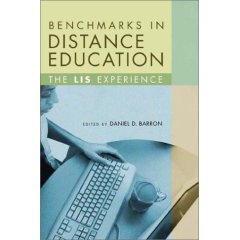
Laura recommends a book edited by Daniel Barron, Benchmarks in Distance Education: The LIS Experience (Westport, CT: Libraries Unlimited, 2003). She calls this the "ultimate source" on distance ed in library education. This collection of essays addresses a wide swath of issues of interest to students thinking about a distance program and for teachers embarking on teaching this way. It's pricey - you may want to look for through your library!

Laura recommends a book edited by Daniel Barron, Benchmarks in Distance Education: The LIS Experience (Westport, CT: Libraries Unlimited, 2003). She calls this the "ultimate source" on distance ed in library education. This collection of essays addresses a wide swath of issues of interest to students thinking about a distance program and for teachers embarking on teaching this way. It's pricey - you may want to look for through your library!
Wednesday, May 31, 2006
Ungagged
Four librarians who were served with National Security Letters and placed under a gag order are finally free to speak up - once the "danger" of discussing the PATRIOT Act before its reauthorization had passed the government decided not to fight against their challenge of the gag order. (Hey, they might lose, and then where would we be? Able to talk first-hand about a controversial law? Horrors.)
See articles in the Boston Globe and The New York Times.
See articles in the Boston Globe and The New York Times.
Monday, May 08, 2006
Peer review patents
Copyright, trademarks, and patents are ways that the government regulates information. In order to tackle the huge backlog of patent applications, the US Patent and Trademark Office will be launching a pilot of a public "peer review" patent system. The goal of the project is "to ensure that patent examiners will have improved access to all available prior art during the patent examination process." There's more here and here. [Via BoingBoing.] If I understand the concept correctly, it's ingenious. I can't wait to see how it works out.
"Traditional" media appear to be struggling...
One of librarianship's research concerns is information-seeking behaviors. It appears that two popular ways of seeking news information (newspapers and cable news) are becoming less so, as some speculate that more people turn to the Internet for news information.
Newspaper circulation declines 2.6%...
Median age of Fox News and CNN viewers is over 60...
Newspaper circulation declines 2.6%...
Median age of Fox News and CNN viewers is over 60...
Subscribe to:
Posts (Atom)